Modernising Legacy Systems: Choosing Between Refactor, Replatform, and Replace
One of the most consequential decisions an engineering organisation can face is what to do with a legacy monolith that’s slowing the team down. I’ve seen teams spend months debating strategy, pick the wrong path, and spend years unwinding the consequences. I’ve also seen teams make a clear-eyed call early and execute a migration that genuinely unlocked velocity.
The honest truth is there’s no universal answer. The right path depends on where the complexity actually lives — in the code, the infrastructure, the data model, or the organisational structure around the system. Getting that diagnosis right is the work.
Three Strategies, Three Different Problems
Legacy modernisation generally comes down to three approaches: refactoring the existing system, replatforming it onto new infrastructure, or replacing it with something new. Each one targets a different root cause.
Refactoring means reshaping the internals without changing what the system does or where it runs. You’re untangling coupled modules, drawing clearer boundaries, and incrementally creating seams that make future extraction possible. The database mostly stays put.
Replatforming is about changing where and how the system runs — containerising the application, migrating from on-premises hardware to cloud, or shifting from VMs to Kubernetes — without fundamentally rewriting the code. The runtime environment changes; the application logic largely doesn’t.
Replacement means building new capabilities from scratch to progressively absorb what the monolith currently does, typically module by module. It’s the most expensive path upfront and carries the most execution risk, but sometimes it’s the only realistic option.
When Refactoring Is the Right Call
Refactoring earns its place when the monolith isn’t architecturally broken — it’s just become tangled through years of growth. If the codebase is reasonably well tested, written in a language the current team knows well, and the problems are more about blurred module boundaries than deep structural decay, refactoring can deliver most of the benefits at a fraction of the cost of a full replacement.
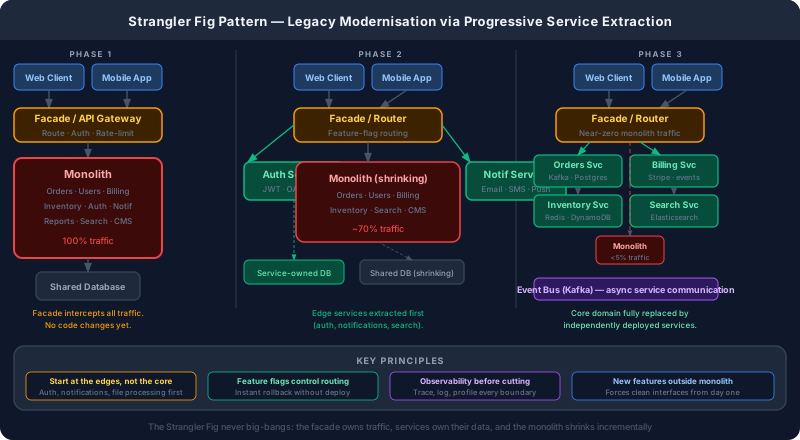
The approach that works here is incremental extraction: identify bounded contexts within the code — areas that could logically stand alone — and build service interfaces around them while they’re still inside the monolith. You’re not carving anything out yet; you’re creating the seams. Over time, you extract those contexts one by one, strangling the monolith gradually. The risk stays manageable because you can pause, learn, and reverse course at any step.
Where refactoring fails is when the code is too opaque to reason about safely — legacy languages, no test coverage, institutional knowledge that walked out the door years ago. And if the bottleneck is actually the runtime environment rather than the code itself, refactoring the application won’t move the needle.
Replatforming: When Infrastructure Is the Constraint
If the codebase is reasonably sound but the infrastructure can’t keep up — slow provisioning, poor resource utilisation, painful scaling — replatforming is often the most pragmatic move. Lifting the monolith into containers and running it on Kubernetes doesn’t give you microservices, but it does give you consistent environments, faster deployments, better resource efficiency, and a foundation you can build on without waiting for data centre cycles.
The important caveat is that replatforming doesn’t fix structural problems in the code. If the application has circular dependencies and a God object database schema, moving it to the cloud just gives you a distributed version of the same mess with better uptime. You still can’t deploy components independently. The database is still a global coupling point.
What replatforming does buy you is time and optionality. New services can be introduced alongside the monolith without waiting on legacy infrastructure constraints. Teams can start gaining experience with the new environment while the monolith continues running. It’s a meaningful step forward without requiring the organisation to bet everything on a big-bang rewrite.
Replacement: When You Need a Clean Start
Sometimes the right call is to stop trying to work around the existing system’s limitations and build forward. This is the case when the data model is fundamentally misaligned with how the business actually operates today, when the technology stack has no viable upgrade path, or when the cost of every new feature is multiplied by years of accumulated complexity.
The key principle here is incrementalism. Big-bang rewrites — where the team goes dark for eighteen months and emerges with a new system — have a poor track record. The approach that tends to work is building new services with clean boundaries and explicit contracts, running them alongside the old system, and routing traffic progressively. A translation layer between old and new handles the impedance mismatch during the transition period; event-driven architectures work particularly well for this.
The hardest part of replacement is almost never the code — it’s the data. Running dual writes to both old and new systems, building reconciliation processes to surface inconsistencies, and having tested rollback paths at every migration step is unglamorous work, but it’s what determines whether the migration succeeds or not.
Trade-offs That Only Become Apparent in Production
There are a handful of architectural trade-offs that read as obvious in theory but become viscerally concrete once the system is running in production.
Transactional consistency. When a monolith splits into services, you lose the single-database transaction boundary. Distributed transactions exist, but they’re complex and fragile. Most teams end up designing around eventual consistency — which means building for failure modes that simply never existed in the monolith. This requires a different mental model, and teams that don’t make that shift explicitly tend to end up with subtle data integrity issues.
Operational complexity. Microservices let teams deploy independently, which accelerates delivery when the organisation is ready for it. But operating dozens of services is categorically different from operating one application. Teams that aren’t set up for distributed tracing, centralised logging, and on-call rotation across service boundaries often find that microservices slow them down rather than speed them up, at least initially.
Data coupling. The promise of service ownership — that a team controls its domain end to end — only holds if the service owns its data. If multiple services continue to share a database, the decoupling is an illusion. One schema change can still cascade across teams. Real independence requires data ownership, which usually means migrating data as well as code.
Migration Patterns Worth Knowing
A few approaches come up repeatedly in migrations that go well, regardless of which strategy you’ve chosen.
Don’t start with the core domain. Begin at the edges — authentication, notification services, file processing, reporting pipelines. These tend to have cleaner boundaries, fewer business rule dependencies, and lower blast radius if something goes wrong. Save the complex, high-traffic core flows for when the team has built confidence with the new architecture.
Build new features outside the monolith. When new functionality is required, write it as a new service from day one. It never touches the monolith’s codebase, forcing you to define a clean interface, and it gives the team real experience with the new architecture before the harder extraction work begins.
Invest in observability before you start cutting. You cannot safely decompose a system you don’t fully understand. Before the first service extraction, instrument everything — distributed traces, structured logging, latency metrics at each integration boundary. Map the dependency graph. Profile what’s actually slow. That groundwork pays dividends when something inevitably breaks mid-migration.
Use feature flags to control the transition. The ability to route traffic between old and new implementations, roll back instantly, and run shadow testing in production is worth the engineering investment. Feature flags give you the control you need to migrate incrementally without requiring a maintenance window.
The Strategic Frame
If there’s a single lesson from watching these projects succeed and fail, it’s that the choice of strategy matters less than the clarity of intent behind it. Teams that enter a migration with a vague mandate to “modernise” or “move to microservices” tend to lose direction. Teams that can articulate specifically what outcome they need — lower deployment risk, independent team velocity, infrastructure cost reduction, or something else — make better trade-offs at every decision point.
The goal is never to eliminate the monolith because monoliths are inherently inferior. The goal is to build a system that lets your team move faster with less risk. Sometimes that’s microservices. Sometimes that’s a well-structured modular monolith running on modern infrastructure. The architecture should serve the engineering organisation’s actual needs — not the other way around.
Start with the right diagnosis. The strategy follows from there.